
Discover a simple nighttime skin care routine that works WITH your skin's natural repair cycle. Learn why fewer products at night means better results by morning.

Here's something most people get wrong about their nighttime skin care routine: they think more products will equal better results.
I used to think that too. My bathroom counter was full of different serums, masks, and facial oils.
And my skin? It was confused, irritated, and maybe a little mad at me.
But then I learned something that really changed the game: your skin already knows what to do at night. It doesn't need a ten-step routine. It needs support, not interference.
Let me show you what I mean.
Why Your Skin Works Harder While You Sleep
This isn't just marketing talk. There's actual science behind why your nighttime skin care routine matters more than your morning one.
While you're sleeping, your skin shifts into repair mode. Cell turnover increases by up to 300% at night. Blood flow to your skin peaks around midnight. Your body produces more collagen and elastin during deep sleep than at any other time.
Think of it like a construction crew that only works the night shift. During the day, your skin is in defense mode, fighting off UV rays, pollution, and environmental stress. But at night? That's when the real building happens.
Here's the thing: if you pile on too many products, you can actually slow down this natural process. Heavy layers can clog pores, trap bacteria, and prevent your skin from breathing and doing its thing.
The goal isn't to DO more. It's to support what your skin already does naturally.
My Simple Nighttime Skin Care Routine (Only 4 Steps, That's It)
After years of experimenting (and yes, making plenty of mistakes), I've landed on a routine that's simple, effective, and actually enjoyable. No twenty-minute rituals. No complicated layering sequences. As busy moms, we don’t have time for that!
This routine is just four steps that work WITH your skin's natural repair cycle.
Step 1: Cleanse Gently But Thoroughly

Everything starts with a clean canvas. You cannot skip this step. I don't care how tired you are.
Throughout the day, your skin collects makeup, sunscreen, dirt, oil, and pollutants. If you don't remove all of that before bed, you're essentially asking your skin to repair itself while covered in debris. Not very ideal.
I use a vitamin C cleanser that removes everything without stripping my skin. If you wear makeup or sunscreen (which you should), I would recommend double cleansing. Your first cleanse is to break down the products, and the second cleanse is to clean your skin.
The keyword here is gentle. Your nighttime cleanse shouldn't leave your skin feeling tight or squeaky. That's a sign you've stripped away too much.
Step 2: Tone With Witch Hazel
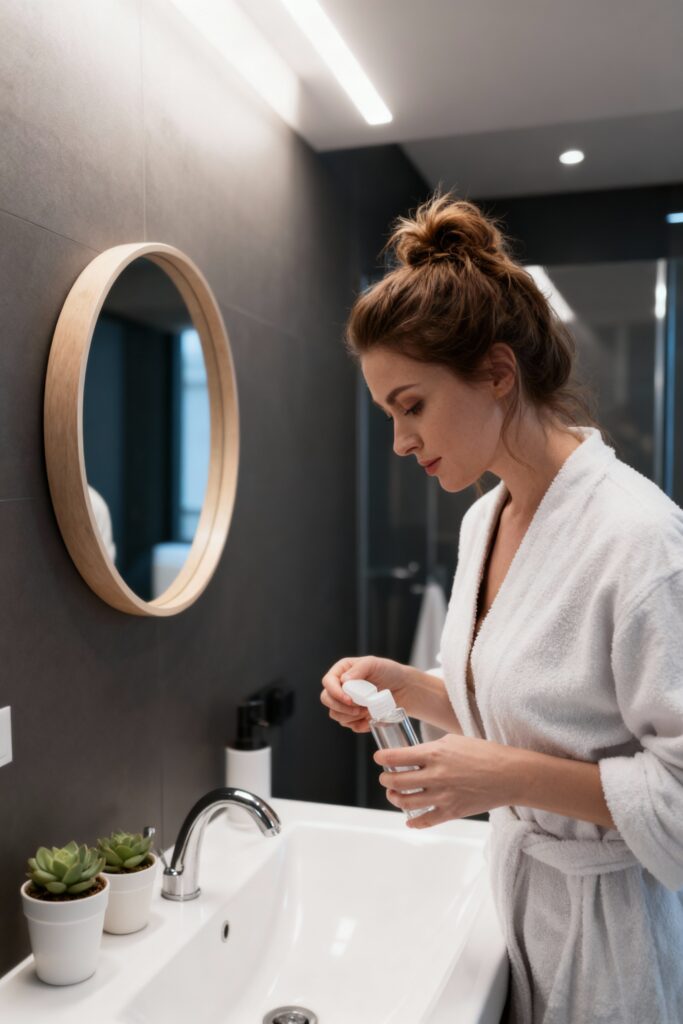
Okay, let’s talk about witch hazel for a second! Because I feel like this ingredient gets very overlooked, and it shouldn't.
Witch hazel is a natural astringent that comes from the bark and leaves of the witch hazel shrub. People have used it for centuries. Your grandmother probably had a bottle of it somewhere.
Here's why I love it for my nighttime skin care routine:
→ It balances your skin's pH. After cleansing, your skin's pH can be thrown off. Witch hazel helps bring it back to its happy place, which means your other products will absorb better.
→ It tightens pores without drying. Unlike alcohol-based toners that can strip your skin, witch hazel gently tightens and refines pores while keeping moisture intact.
→ It calms inflammation. Had a stressful day? Your skin probably shows it. Witch hazel has natural anti-inflammatory properties that help soothe redness and irritation.
→ It's antibacterial. This is huge for anyone prone to breakouts. Witch hazel helps keep bacteria at bay without harsh chemicals.
I apply it with my hands after cleansing, but you could also use a cotton pad. It feels refreshing and preps my skin perfectly for the next step.
→ One tip: look for alcohol-free witch hazel. Some drugstore versions add alcohol, which defeats the purpose. You want the pure stuff.
Step 3: Apply Your Retinoids

This is where the real nighttime magic happens.
If you're not using a retinoid at night, you're missing out on one of the most researched, proven ingredients in skin care. Retinoids (which include retinol, retinal, and prescription tretinoin) increase cell turnover, boost collagen production, and help with everything from fine lines to acne to uneven skin tone.
I use this retinal, and here's why I chose retinal specifically over regular retinol:
Retinal (also called retinaldehyde) converts to retinoic acid in just one step, while retinol takes two steps. That means retinal works faster and more efficiently, but it's still gentler than prescription options. It's the sweet spot.
A few retinal tips:
- Start slow. Two to three nights a week at first, then build up.
- A pea-sized amount is plenty for your whole face.
- Apply to dry skin. Damp skin increases absorption, which sounds good but can actually increase irritation.
- Be patient. Real results take 8-12 weeks.
If you're new to retinoids, your skin might purge a bit at first. This is normal. It's your skin pushing out the gunk that was hiding beneath the surface. Push through it, and it’ll get better.
Step 4: Seal Everything In With Jojoba Oil

Here's where most people add a heavy night cream (which is totally ok), but I don't.
Instead, I use jojoba oil as my final step. And there's a specific reason why.
Jojoba oil isn't technically an oil. It's a liquid wax that closely mimics your skin's natural sebum. When you apply it, your skin basically goes, "Oh, I recognize this," and absorbs it beautifully.
This does a few important things:
It locks in hydration without feeling heavy or greasy, so your skin can still breathe.
It balances oil production. I know this sounds backward, but applying oil can actually help oily skin produce LESS oil. When your skin feels hydrated, it doesn't overcompensate by producing excess sebum.
It supports your skin barrier. A healthy skin barrier means better protection and faster healing. Jojoba oil reinforces that barrier overnight.
I warm 3-4 drops between my palms and press it into my skin. I wake up with skin that feels soft, healthy, and balanced, and it’s never greasy.
A Note on What Else Works at Night

I keep my routine very minimal, but that doesn't mean yours has to look exactly like mine. Here are a few things worth knowing:
Vitamin C works at night, too. There's this myth floating around that Vitamin C is only a "daytime ingredient." But that’s not true. Yes, it pairs beautifully with sunscreen during the day for antioxidant protection. But at night? It's still doing its job, supporting collagen production, brightening, and helping with repair. If your skin tolerates it well with retinol, you can absolutely use both. Here's my full breakdown on how to use vitamin C serum.
Sometimes you DO need a heavier moisturizer. Less is more doesn't mean depriving your skin when it's asking for help. In winter, when the air is dry, and your skin barrier is working overtime, a richer cream on top of your oil can be exactly what you need. Listen to your skin. If it feels tight or parched in the morning, add that extra layer.
What I skip: Multiple strong activities in the same routine. Don't mix your retinol with AHAs, BHAs, or other potent exfoliants at the same time. Pick one per night. You don’t want to make your skin a chemistry experiment.
Also, skip: Anything with synthetic fragrance. Nighttime is when your skin is most permeable. Fragrances can cause irritation and sensitivity, especially when left on for 8 hours.
How This Fits With Your Morning Routine
Your nighttime skin care routine and morning skin care routine should work together, not compete.
Think of it this way: nighttime is for repair and treatment. Morning is for protection and prevention.
At night, you're supporting cell turnover and using your retinoids. In the morning, you're defending against the day ahead with antioxidants and sunscreen.
When both routines are dialed in, they create a 24-hour cycle that keeps your skin healthy, balanced, and actually improving over time.
The Bottom Line

Your nighttime skin care routine doesn't need to be complicated. In fact, the simpler it is, the better it works.
Four steps. Less than five minutes. Products that support what your skin already does naturally.
That's it.
Your skin is smart. It knows how to repair itself. Your job is just to give it a clean surface, the right tools, and then get out of the way and let it do its thing.
Tonight, try this: double cleanse, tone with witch hazel, apply your retinol, seal with jojoba oil. Then go to sleep and let your skin do what it was designed to do.
You might be surprised by what you wake up to.

This post was all about the best nighttime skin care routine that actually works.